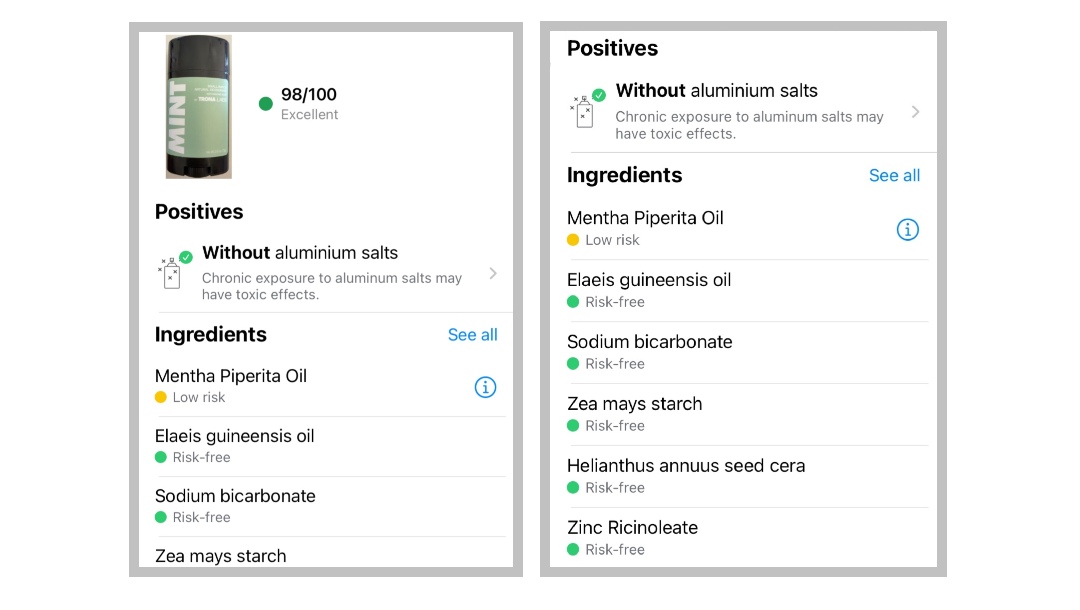
We scanned MINT with the Yuka app and got a 98 out of 100. We’re proud of that result — but a number without context can invite more confidence than it deserves, so here’s the honest version.
What Yuka is actually measuring
Yuka helps consumers make better choices for their health. Scan a product’s barcode, and its own database of 12,500+ cosmetic ingredients gives a score from 0 to 100. More than 20 million people in the U.S. use Yuka. The score isn’t an average. It’s based on the level of the highest-risk ingredient present in the product, so one flagged ingredient can tank the whole formula’s score, even when everything else is simple.
The score
98/100. Excellent.
Yuka’s own top-tier scoring band puts “Excellent” at 75 to 100 — the highest a cosmetic product can reach. 98 is rarefied air. On Yuka’s own Top 10 UK deodorant ranking, most “excellent” deodorants sit in the high 80s to low 90s, and only a couple of aluminum-free formulas break into the high 90s.
Why trust the number at all? In Yuka co-founder Julie Chapon’s own words: “People trust the app and our [product] evaluations because we’re independent.” No brand can pay for a better score, and Yuka takes no money from brands or manufacturers. That’s the entire premise the score rests on.

Screenshot: Yuka’s scan result for MINT Natural Deodorant by Trona Labs, taken directly from the app.
The app’s first callout on MINT is a green-checked “Without aluminium salts,” with Yuka’s own note that “chronic exposure to aluminum salts may have toxic effects.” That’s really the heart of why a baking-soda formula lands so differently than a conventional antiperspirant in Yuka’s system.
It’s not the end-all-be-all
Yuka’s method draws from sources like the EU’s SCCS, ECHA, and IARC, and applies caution when evidence merely raises suspicion, rather than waiting for certainty. That’s useful, but it isn’t the same as a full risk assessment. Cosmetic chemist Perry Romanowski put it plainly: “Yuka is not a regulatory authority and its rating system is not based on science.” The New York Times’ Wirecutter made a related point: scanning apps “can’t address one of the fundamental principles of toxicology: the dose makes the poison.”
All of that said, we’re still honking our own horn here.

A great score, and an even better dog.
Still have questions?
We’ve covered irritation, ingredients, and everything else people ask us most often over on our FAQ page. And if you’re curious about exactly what’s in the stick and why, the Ingredients page breaks down all six.